
Franklin County 72-Hour Release Gap
The Franklin County Sheriff’s Office does not offer an official page for “released in the last 72 hours,” “recent releases,” or any other rolling book-out window. Its public Arrest Log is a dated record of arrests. The page identifies such facts as name, city, race, sex, age, arresting agency, arrest date, and charge text. It does not publish current custody, booking number, release date or time, release reason, bond outcome, or release destination.
A three-day inquiry therefore cannot be answered by scrolling to three dates on that page. Arrest time and release time are separate. Someone arrested before the period might leave during it, while someone arrested during the period might remain held. Older arrest entries also persist. The correct approach defines the date range, identifies all possible booking episodes, and asks FCSO for release events within that range.
No rolling list exists. Treat the three-day window as a records period, not as a filter available on the sheriff’s website.
Check Franklin County Three-Day Releases
A 72-hour check needs fixed start and end times. “The weekend” can mean different periods, so give FCSO exact dates and times when possible. Add the person’s name, arrest date, case number, and booking number if known. That detail reduces the risk of mixing people with similar names or combining separate arrests.
- Set the window. Record the exact start date and time, end date and time, and whether the inquiry concerns county jail departure or return to the community.
- Use the Arrest Log only to identify names, arrest dates, agencies, and charges connected with possible bookings.
- Call FCSO at 850-670-8500 or file a Chapter 119 request for release events and the related booking records in the defined period.
- Search the Franklin Clerk criminal docket for each matched case. Read release forms, bond orders, judgments, dismissals, sentences, and commitment entries.
- Use Florida VINE to check a named person’s custody status. Use FDC, BOP, or ICE when the sheriff record identifies a transfer to that custodian.
The Franklin County 24-hour release check is better for a same-day event that may still be moving through feeds. The three-day method places more weight on the court file and written sheriff record because those sources remain useful after an alert has passed.
Franklin County 72-Hour Release Fields
Because no public table exists, request a record set that can be sorted by actual release time. Ask FCSO whether it can provide a report for the date range and whether any exempt fields must be withheld. If a report is not readily available, request each matched booking’s release portion. Lawful copying or extensive-use costs may apply, but the research establishes no fixed price for this particular report.
| Field | Use in a three-day review |
|---|---|
| Name and booking number | Keeps each release tied to one custody episode. |
| Admission date and time | Shows that a release may concern an arrest from before the window. |
| Release date and time | Places the event inside or outside the exact 72-hour period. |
| Release code and reason | Identifies bond, court order, time served, completion, or transfer wording. |
| Authority or order | Points to the court, bond action, or agency basis for departure. |
| Destination or receiver | Shows community return or the next government custodian. |
| Holds and detainers | Explains why county release might lead directly to other custody. |
The sheriff’s release field should not be used as the final court result. A booking charge can change later. The Franklin Clerk docket preserves later filings and disposition, while the sheriff record is the better source for physical departure time.
Weekend Franklin County Release Checks
A wider period is useful when an event crosses the line between workdays. A late Friday custody change may not be reviewed until Monday. A court order, bond process, or transfer can also be entered into one system before another source reflects it. Franklin County publishes no guaranteed web-update interval for the arrest log, so a visible posting pattern must not be converted into a promise that all events appear by a set hour.
Start with the exact 72-hour range and preserve the access time for every source checked. If VINE reports “Out of Custody,” note which contributing agency supplied that status. The phrase means the person is out of that contributor’s custody. It does not exclude transfer, a detainer, or supervision. Ask FCSO for the receiving agency and check the Clerk for the release authority.
The Clerk file is especially useful once the period has closed. Franklin’s felony guidance says the official case file includes the original arrest document and any release form after county jail release. A docket statement can also show a bond order, dismissal, sentence, commitment, or later warrant. Those entries survive the short window that a hypothetical recent-release feed would cover.
Note: Define a weekend search with exact dates and times; no official Franklin rolling clock is available to apply automatically.
Franklin Release Archive Window Quirk
Franklin’s current Arrest Log is deeply paginated, and a separate Arrest Log Archive holds older reports. Neither source is a 72-hour release archive. The current page lacks release status, time, reason, booking number, and inline photos. Older reports may contain bond or bail context and point readers to the sheriff app for arrest photographs. Those differences show how the publication changed, not whether a person left jail in the last three days.
The official archive can be viewed in the source image below. Open the FCSO Arrest Log Archive to check the live page and its own description.
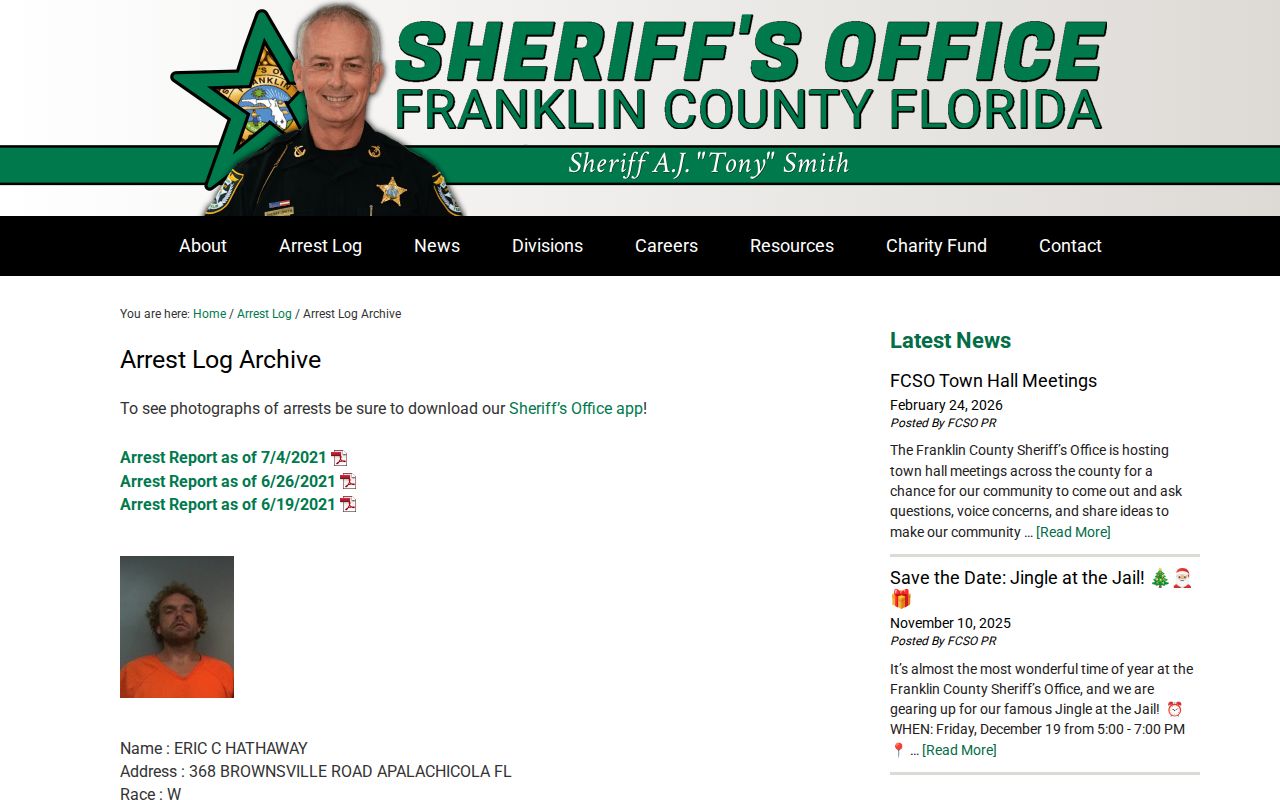
Pagination and disappearance are both weak evidence. A name may move deeper into history because new arrests were added. An older report may remain accessible long after custody ended. Only a dated release field or release form ties the person to the requested three-day period.
Franklin County Release Record Trail
Three official layers can be reconciled. First, FCSO’s booking and release record answers when county custody ended, why it ended, and where the person went. Second, the Franklin Clerk’s Public Court Search route supplies docket statements and filed authority. Third, VINE can show a custody change from a participating contributor. Agreement among those sources is stronger than any one screen viewed without context.
Request precise terms from the sheriff: release date and time, release type, release authority, destination or receiving agency, and any holds or detainers. If a short code appears, ask for its legend. In the court file, distinguish a bond order from final disposition. Bond is a pretrial custody decision. Dismissal, judgment, sentence, and commitment each answer different legal questions.
- Release form
- A filed document recording authority or action connected with departure from county jail.
- Disposition
- The court’s recorded resolution of a charge or case, not merely an arrest or book-out event.
- Detainer
- A request or hold connected with another authority that may affect where the person goes next.
- Discharge
- The end of a stated custody or supervision term, when the responsible agency uses that status.
Custody After a Franklin Release
Leaving Franklin County Jail does not always mean leaving custody. A person may go to the community on bond, recognizance, dismissal, time served, or completion of a county sentence. Another record may show transfer to the Florida Department of Corrections, another county, the United States Marshals Service, the Bureau of Prisons, or ICE. State and federal systems must be checked only when the record points there.
FDC separates current prisoners, released or scheduled-to-release people, and people under community supervision into different searches. A person transferred from the jail to FDC should first appear through the state population route, not as a county community release. A later state-prison release belongs in FDC’s Inmate Release Information Search. Federal sentenced custody belongs in the BOP Locator. An immigration transfer calls for ICE checking. The county record should name the receiving agency.
| Recorded outcome | Next confirmation |
|---|---|
| Bond, recognizance, or court release | FCSO release record plus Clerk docket and release form. |
| Commitment or transfer to FDC | FDC Inmate Population search, then FDC release data when applicable. |
| Transfer to another county | The named county jail or sheriff custodian. |
| Federal transfer | USMS court/records route or BOP Locator, based on custody type. |
| Release to ICE | ICE locator or ERO route, recognizing that county custody ended but immigration custody may have begun. |
Verify Older Franklin County Releases
An event that falls outside the three-day period should move directly to durable sources. Search the criminal case, then request the booking and release record by name, arrest date, case number, and booking number. No official source states how long FCSO keeps an internal release record or publishes a release record online, because no public release display exists. Ask the records custodian which retention schedule applies when the episode is old.
A no-result is not proof of release. Check spelling, aliases, prior surnames, initials, and whether the person belonged to the custody system being searched. FDC does not contain every county-jail booking. The BOP locator is limited to federal custody, ICE has limited recent-release visibility, and the FDLE registry concerns only people subject to registration. The right end product is a record tied to the right person, episode, release time, reason, and destination.