
Franklin County Projected Versus Actual Release
A projected date is a calculation made before release. An actual release date records a custody event that has occurred. Florida’s state-prison law uses the term tentative release date, or TRD, for a term-of-years sentence adjusted by lawful credit and gain-time. The date may move as the sentence record changes. It is not a guaranteed pickup time.
Custody type comes first. A person awaiting trial at Franklin County Jail may leave after bond, recognizance, dismissal, a court order, transfer, or another event. There is no fixed sentence-completion date before a sentence exists. A sentenced county prisoner may have a local jail computation. A person at Franklin Correctional Institution has a state FDC computation. Movement from the county jail to FDC or to another custodian is a transfer, not community release.
Scheduled vs actual: A future Franklin County release date is a planning value. Confirm departure through the jail, FDC release record, court file, or VINE.
- Tentative release date
- FDC’s statutory calculation after current credit and gain-time are applied.
- Maximum sentence expiration
- The end of a term-of-years sentence after lawful time credit, distinct from the tentative date.
- Gain-time
- Credit that may reduce time served under the governing state or county framework.
- Detainer
- A hold or request from another authority that can affect where a person goes when one custody term ends.
Find a Franklin County Projected Release Date
Use the system that computes the sentence. The FDC Inmate Population Search covers present Florida state prisoners, including a person at Franklin Correctional Institution. It is not a Franklin County Jail roster. For a county sentence, request the jail’s sentence computation and compare it with the judgment and credit in the Franklin Clerk docket.
- Confirm whether the person is pretrial, serving a county sentence, or serving an FDC sentence. Agency, facility, and case details prevent a same-name error.
- For current state incarceration, search FDC by last name, first name, or DC number. A DC number is the strongest match when available.
- Open the population detail and read the exact public label, Current Release Date. Do not rename that screen field or treat it as an accomplished release.
- For a county sentence, obtain the sentencing order, court-awarded jail credit, and Franklin County Jail computation. Ask which local gain-time policy was applied.
- When the date has immediate importance, confirm with the FDC Bureau of Admission and Release or the jail. Check VINE for a custody-change alert, not a certified calculation.
The official FDC population search is the correct public entry for a current state prisoner’s displayed date.
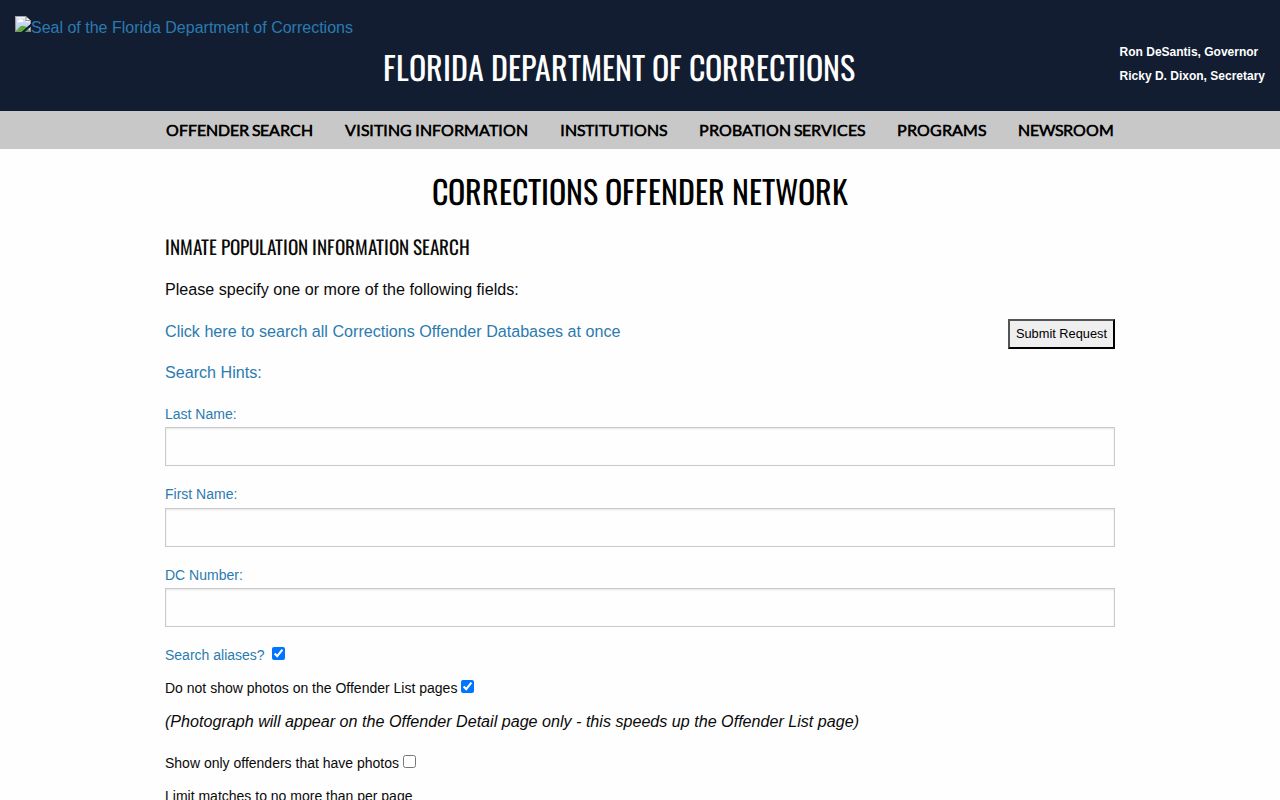
This landing screen leads to population details. The matching detail must be checked live because names collide and FDC warns that status, location, and release data can change quickly.
The Bureau of Admission and Release handles release-data questions at 850-488-9167 or dc.release@fdc.myflorida.com. Classification and Central Records can address population or classification data at 850-488-9859 or central.classification@fdc.myflorida.com. A past state-prison release belongs in the separate FDC Inmate Release Search rather than the active population database.
FDC Current Release Date Label
Two official phrases describe related parts of the state-prison calculation. The public active-inmate detail labels its field Current Release Date. Florida Statutes § 944.275 calls the underlying gain-time calculation a tentative release date. Accuracy requires keeping both labels in their proper channels. The search screen should not be quoted as saying “Tentative Release Date,” and the statute should not be described as naming the public field.
The official text of Florida Statutes § 944.275 directs FDC to establish a tentative release date for a prisoner sentenced to a term of years. It separately describes the maximum sentence expiration date reduced by lawful time credit.
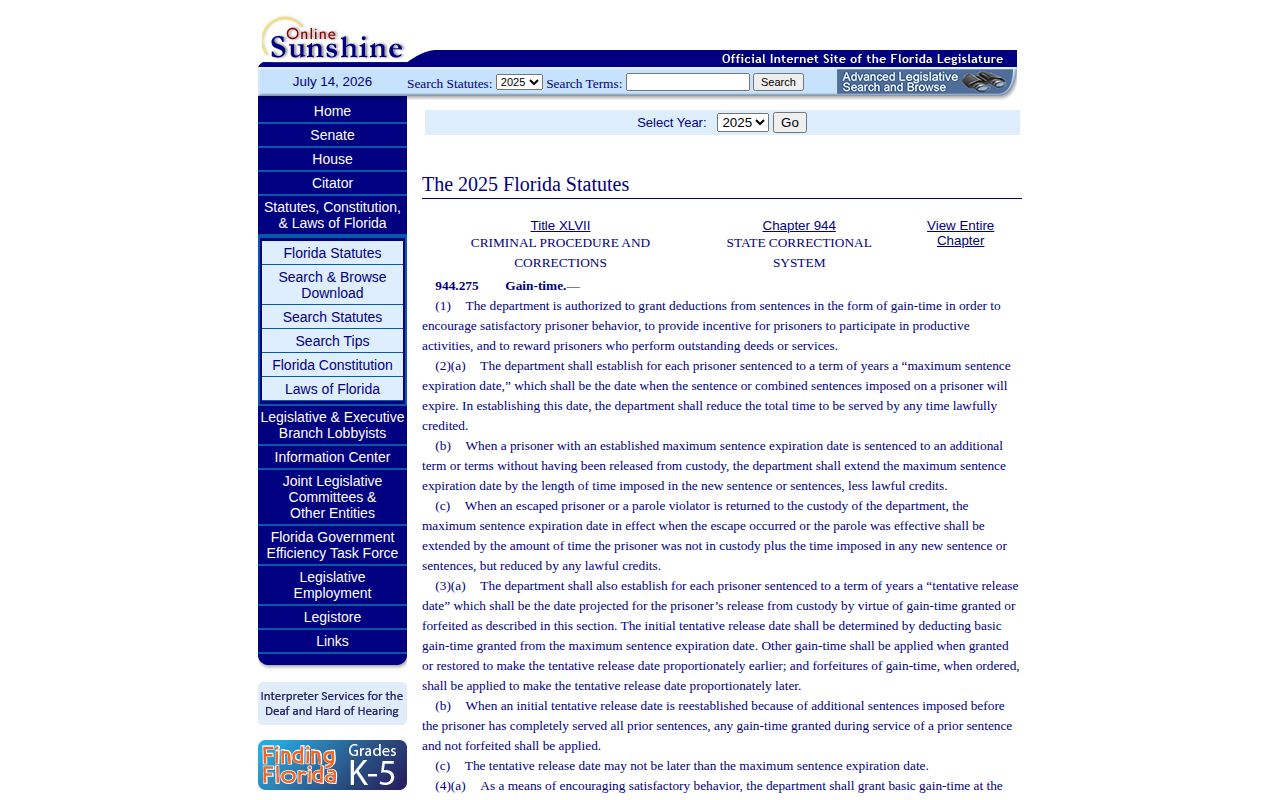
The statute supplies the rules behind the calculation. It does not establish that any one prisoner will leave on the date visible in a prior screenshot.
FDC’s population and release searches also represent different moments. Population means present FDC incarceration. Inmate Release covers released or scheduled-for-release information. If a displayed date passes while the person remains in Population Search, do not infer that release occurred. Ask FDC to reconcile the status.
The Inmate Release detail can contain a release date, stated residence upon release, detainers, aliases, incarceration history, and offense or sentence data. Some release-date positions may contain non-date text such as “DECEASED,” so the actual value must be read rather than forced into a calendar format. FDC says release information is updated nightly. A saved result is therefore a dated database observation, not a permanent certificate.
Franklin County State Release Computation
A simplified state-prison model begins with the imposed sentence. FDC then accounts for lawful jail or prison credit, sentence structure, and gain-time currently awarded or available. Mandatory minimums and other statutory limits can constrain the result. This model helps explain the record, but it is not safe for calculating an individual date from sentence length alone.
For qualifying offenses committed on or after October 1, 1995, § 944.275(4)(f) prevents gain-time from producing release before at least 85 percent of the sentence imposed has been served. Court-awarded credit for physical incarceration counts toward that percentage. Some mandatory minimums, offense-specific exclusions, or full-service rules can require more. Life sentences are not converted into ordinary term-of-years estimates.
Gain-time may be awarded, forfeited after discipline, or restored. Historical rules depend on offense date. A new sentence, amended order, corrected commitment record, or recalculation can also alter the tentative release date. This is why the FDC field is current, not permanent.
Note: The 85-percent floor applies to the qualifying state-prison framework, not automatically to an ordinary Franklin County Jail sentence.
Franklin County Jail Release Computation
County time follows different law. Florida Statutes § 921.161 requires the sentencing court to credit time spent in county jail before sentence. Section 951.21 supplies a county-prisoner gain-time framework unless the county commission elects to discontinue or revise the policy.
The statutory schedule permits up to five days per month in the first and second years, up to ten days per month in the third and fourth years, and up to fifteen days per month in the fifth and later years. It also allows up to five extra days per month for meritorious conduct or exceptional industry. Gain-time can be forfeited through the local statutory process.
No official Franklin County policy found in the research confirms whether the county commission revised or discontinued that default schedule or how the jail implements it. Section 951.21 is therefore a framework, not proof of a specific award. Request the actual sentence computation from Franklin County Jail at 270 State Road 65, Eastpoint, FL 32328, or call the detention information line at 850-670-8500. The court judgment and credit order provide the other half of the check.
A county case may also lack a sentence date because the person is still awaiting trial. Bond eligibility, a first appearance, later bail action, dismissal, or another court event can control release instead. Neither the state-prison 85-percent rule nor the maximum county gain-time schedule supplies a release date for that pretrial situation. The Clerk docket and jail status are the right channels.
Why Franklin County Release Dates Change
A date can move for a legal, administrative, or conduct-based reason. The record should identify the source rather than leaving the reader to reverse-engineer the math.
| Change | Possible effect | Best record |
|---|---|---|
| Corrected jail credit | Moves the computation after a court or FDC correction | Amended order and current agency calculation |
| Concurrent or consecutive sentence review | Changes how separate terms combine | Judgments, commitment papers, and FDC detail |
| Gain-time award, loss, or restoration | Moves the tentative date earlier or later within the law | FDC calculation or county jail computation |
| Mandatory minimum | Prevents release before the required service | Sentencing order and governing statute |
| New sentence or violation | Adds or restructures custody or supervision | Court or commission action |
| Detainer or receiving authority | Changes the destination after one custody ends | Release record and detainer detail |
A detainer may mean the person leaves one facility but remains in custody elsewhere. Parole or conditional release can end prison confinement while starting supervision. Final discharge occurs only when the relevant sentence or supervision record says it ended.
Confirm Franklin County Release Timing
Pair the calculation with a live event source. Florida VINE can send a custody-change alert from a participating Franklin County jail or FDC feed. It cannot guarantee the exact time of departure and does not replace the sentence computation. The Franklin County VINELink check details search and notification steps.
For county custody, confirm with Franklin County Jail and the Clerk release form or docket. For state custody, compare the FDC Current Release Date with Inmate Release information and contact the Bureau of Admission and Release when values conflict. If post-prison supervision follows, the FDC Supervised Population result may coexist with a completed prison release.
Record the date of access and the exact agency wording. For a legal or court process, request the underlying record instead of relying on an old screen capture. The originating office can also explain whether a detainer, amended sentence, or data correction changed the expected destination.
Note: “Out of Custody” from one VINE contributor does not rule out transfer, a detainer, or continuing community supervision.